Ecommerce SEO Case Study: How We Grew a Skincare Retailer's Organic Traffic 120.8% in 9 Months

Toro has 4+ years of SEO and content marketing experience. At The Inscribe Agency, she leads AEO (Answer Engine Optimization) research, experiments and strategies that drive revenue for clients. Inscribe has generated over $10 million for its clients.
TL;DR
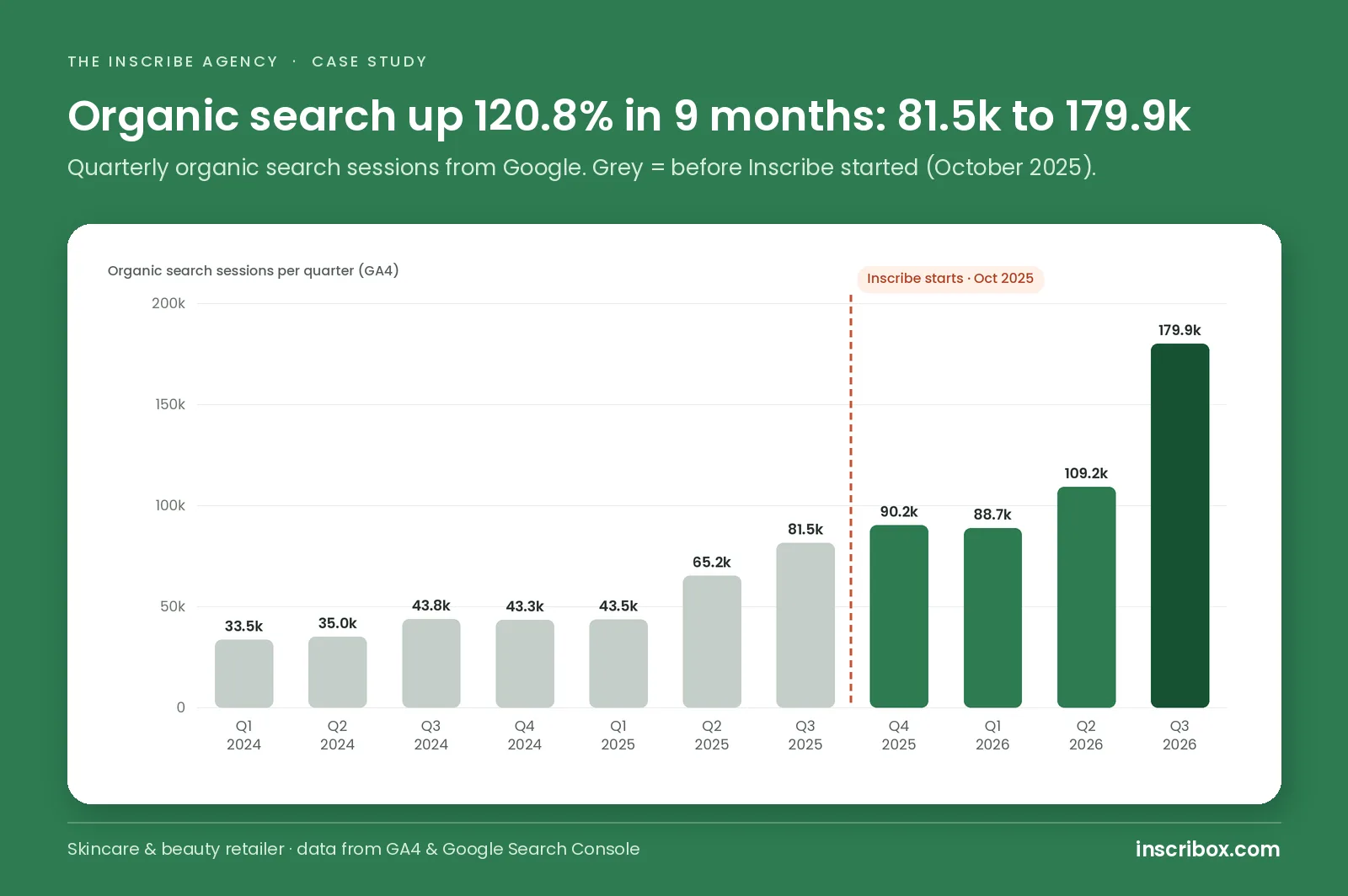
- Organic search sessions rose 120.8% in 9 months, more than doubling from 81,479 in the quarter before we started (Q3 2025) to 179,901 in Q3 2026.
- Average Google position went from 12.1 to 6.7 between September 2025 and September 2026, and monthly Google clicks went from 16,333 to 42,376 (+159%).
- Revenue from organic search rose 151.6%, from $75,932 in our first quarter to $191,067 nine months in, for $534,207 in total since purchase tracking went live.
- Organic search became the #1 traffic channel six months in, overtaking social and direct in Q2 2026.
- AI search is ramping up, with visits from ChatGPT, Gemini, Claude, Copilot and Perplexity growing from 194 in Q2 2026 to 2,035 in Q3 2026 (up 949%).
In late 2025, we had a skincare and beauty retailer reach out to us at the Inscribe Agency for SEO services. Now, Google was already sending traffic to the website, it just wasn’t consistent.
This ecommerce SEO case study follows that store from the quarter before we started to nine months in. In July to September 2025, organic search sent the store 81,479 sessions. That made it the third channel, behind organic social (92,693) and direct traffic (92,054). Nine months after we started, the same channel sent 179,901 sessions in a single quarter and was competing for the top spot.
Same retailer, products, same website.
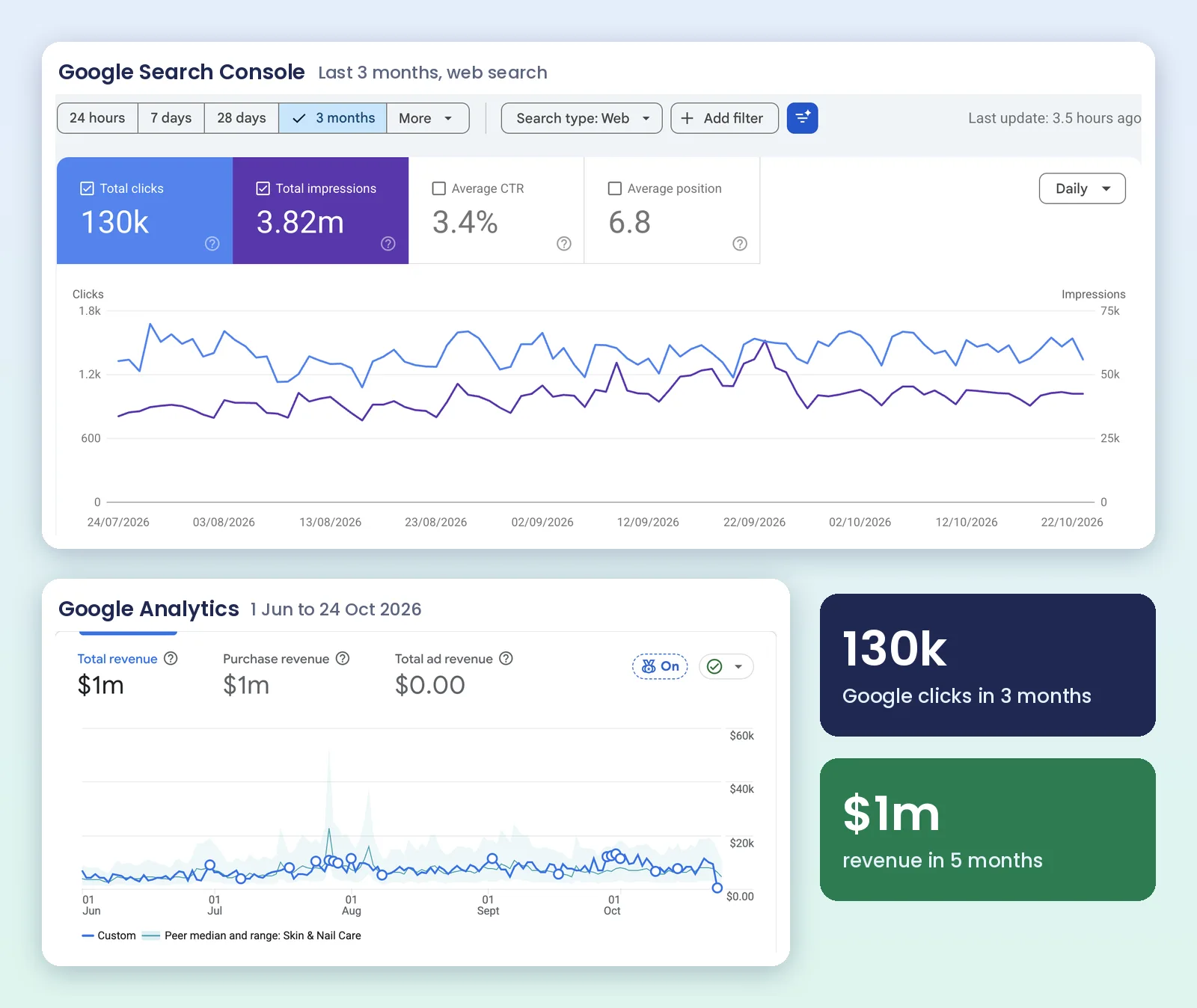
Between 1 June and 24 October 2026, the store passed $1M in total revenue.
Many ecommerce SEO case studies only show the surface. However this one shows all of the work we put in to get the website to where it is currently.
Where Was The Store Before Our Ecommerce SEO Process?
By the way, this wasn't a broken website.
Organic search had grown steadily, from 43,281 sessions in late 2024 to 81,479 in Q3 2025. But it was still the #3 channel, behind social and direct, at 29.1% of all sessions. There was no purchase tracking yet, so nobody could say what search was earning.
And on Google, the store was mostly on page two: its average position in September 2025 was 12.1. So our job was: take a channel that was growing slowly and make it reliable.
Our process had three parts (technical SEO, content and links). It's the same process we use for any DTC or B2C brand. The products can change, but the method doesn't.
Before we dive into the how, here’s the results upfront.
3 Months In (Q1 2026): The Groundwork
Honest truth? Traffic didn't grow this quarter, and it was intentional based on the foundation we had set during the first 90 days. We had several pages reworked. Our aim was to get the website showing higher up, not just traffic alone.
Average position went from 9.8 in January to 7.6 in March, and revenue from organic search rose 22.1% to $92,684.
We fixed how the site was structured, decided which page should rank for which search, and planned the content the store has been missing. It's like laying the foundation for a house: there's not much to admire yet, but everything after depends on it.
6 Months In (Q2 2026): Search Becomes The #1 Channel
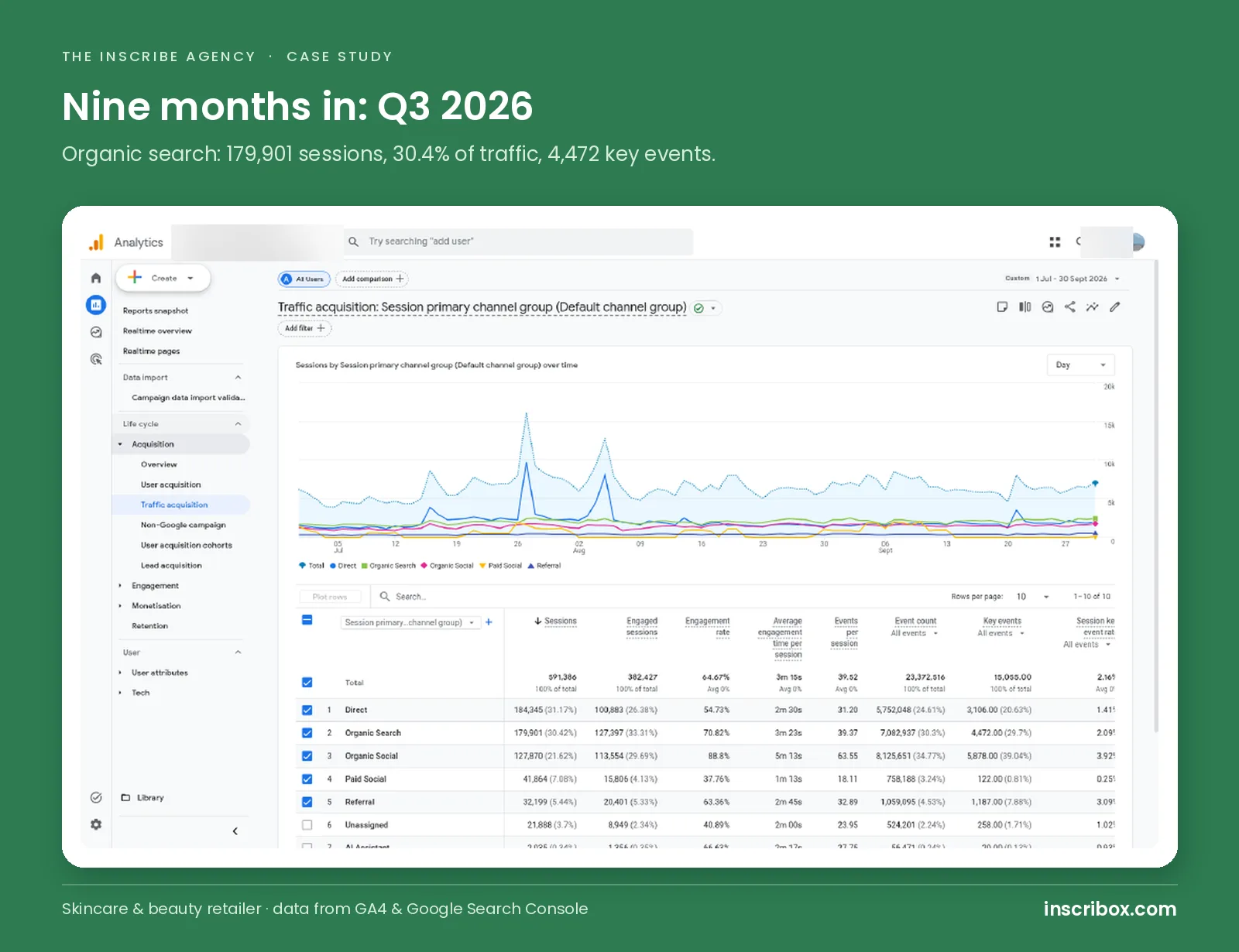
Organic search hit 109,208 sessions in Q2 2026 and became the store's biggest traffic channel, ahead of direct (104,479) and organic social (68,661). Revenue from organic search reached $124,644.
This was also the quarter AI assistants showed up in the numbers: 194 visits from tools like ChatGPT, once GA4 started reporting AI assistants as their own channel.
9 Months In (Q3 2026): The Biggest Quarter Yet
- 179,901 organic search sessions: up 120.8% on Q3 2025, the quarter before we started, and up 64.7% on Q2.
- 127,397 engaged sessions: more than double the 58,475 in Q3 2025, with the average visit lasting 3 minutes 23 seconds (up from 2 minutes 49 seconds).
- $191,067 in revenue from organic search: from 4,472 key events, and 151.6% more than our first quarter.
- 30.4% of all sessions and 28.1% of all revenue on the site: from organic search.
- 2,035 visits from AI assistants: up 949% on the quarter before.
So… how did we get these results?
Step 1: Ecommerce Keyword Research Starts With The Products
The audit pattern we see on most DTC stores looks like this:
- There's no defined keyword strategy.
- The store mostly ranks for its own name, so it's only visible to people who already know it.
- Whatever content exists goes after "top of the funnel" questions and never meets a shopper who's ready to buy.
There are three ways to do keyword research for ecommerce, and we use all three, but not equally.
- Your own domain: drop the store's URL into an SEO tool and filter by intent and position. This shows what already ranks and what's close to page one. Useful, but it only shows you what you're doing now, not what you're missing.
- A competitor's domain: the same thing with a top competitor's URL. You see what's driving their traffic, then target variations or try to outrank them. But the downside is that you end up copying a playbook without knowing why it works, and you miss whatever they've missed too.
- Product seed keywords (the one we lean on): start with what the store sells, put each product type into the keyword tool, then filter for relevance and purchase intent.
For this retailer, that meant listing every product type on the shelves first (cleansers, sunscreens, serums, body lotions, acne treatments and so on) and doing the research one product type at a time.
For each product type we pick one main keyword, then split it three ways by intent:
- Transactional: the shopper wants to buy now (eg "azelaic acid gel"). This goes to a category page or a product page.
- Commercial: the shopper is comparing (eg "best sunscreen for oily skin", "body oil vs body lotion"). This goes to a guide.
- Informational: the shopper is learning (eg "how to use azelaic acid"). This goes to a guide, or into an FAQ on the category or product page.
What An Ecommerce Keyword Cluster Looks Like For A Skincare Store
Here's a cleaned-up example of how a cluster maps out for a skincare store.
| Product type | Transactional (category or product page) | Commercial (guide) | Informational (guide or FAQ) |
|---|---|---|---|
| Azelaic acid | azelaic acid gel, azelaic acid cream, azelaic acid serum, azelaic acid 10% | best azelaic acid serum for dark spots, azelaic acid vs niacinamide | how to use azelaic acid, can you use azelaic acid every day |
| Sunscreen | sunscreen, sunscreen for oily skin, tinted sunscreen | best sunscreen for oily skin, mineral vs chemical sunscreen | how often should you reapply sunscreen, do you need sunscreen indoors |
| Body lotion | body lotion, brightening body lotion | best body lotion for glowing skin, best brightening body lotion, body oil vs body lotion | when to apply body lotion |
| Acne treatments | adapalene gel, benzoyl peroxide gel | best moisturizer for acne prone skin, best serum for pimples and dark spots | purging vs breakout, how to use adapalene |
Step 2: Technical And On-Page SEO For A Skincare Store
Technical SEO for an online store isn't only page speed and error reports. Most of the wins come from structure: which pages exist, what they're called, and what each one is there to rank for.
- Purchase tracking first: purchase tracking in Google Analytics 4 went live in the first few weeks. Before October 2025, nobody could say what search earned the store.
- Name category pages the way shoppers search: this is the mistake we see most on DTC stores. A brand launches a range with a made-up name, and the category page gets that name and that URL. Nobody searches for a made-up name. They search for the product. So category pages get the product name people type into Google, and the URL matches it. A slug like /body-oils, not /summer-glow-edit.
- One category page per variation that people search for: if enough people search for a variation (a skin type, a strength, a size, a use), it gets its own category page instead of a filter nobody can find on Google. "Body oil" and "men's body oil" are two different searches, so they're two different pages.
- One page per search: the keyword map decides which page ranks for which search, so the category page, the product page and the guide aren't all competing for the same term.
- Product pages written for search, not just for the catalogue: the product pages we optimise use the name a shopper would search for, answer the questions people ask before they buy in an FAQ on the page, and keep the product details clean and structured so Google and LLMs can read them.
Step 3: Skincare SEO Strategy Built For Topical Authority
The store's job is to sell. The blog's job is different: to become the most useful skincare resource for the store's shoppers, so that when they're ready to buy, the retailer is the name they already trust.
We started with who the blog was for:
- Skincare enthusiasts who want genuine products and are tired of fakes.
- First-time buyers trying to work out where to start.
- People with a specific concern: acne, dark spots, ageing.
- K-beauty and international skincare fans, etc
Then we built the plan around topic pillars like these:
- Acne types and treatment
- Hyperpigmentation
- Sun damage and sunscreen
- Age-based skincare
- Ageing concerns
- Skin types, etc
Then each pillar breaks down into content buckets, with specific topics that live under it. Why go that deep? It’s because Google rewards the site that covers a topic fully, not the site with one good article on it. One guide on sunscreen is a page. Thirty connected guides on sunscreen is a reason for Google and LLMs to treat the store as the place to send sunscreen shoppers.
In Q3 2026, guides and product reviews brought in 12,079 organic sessions, becoming top earners.
Step 4: Links, Citations, Directories
The third part of our process is links: other websites pointing to the store. Google treats a link from a relevant, trusted site the way you'd treat a recommendation from a friend who knows the subject.
We point links at pages that already deserve to rank (strong category pages and the guides at the centre of each pillar), so every link has somewhere useful to send its authority. Content and structure come first. Links make good pages rank faster. They don't rescue weak ones.
What Changed On Google After Our Ecommerce SEO Strategy?
The whole store started ranking for more of what shoppers search.
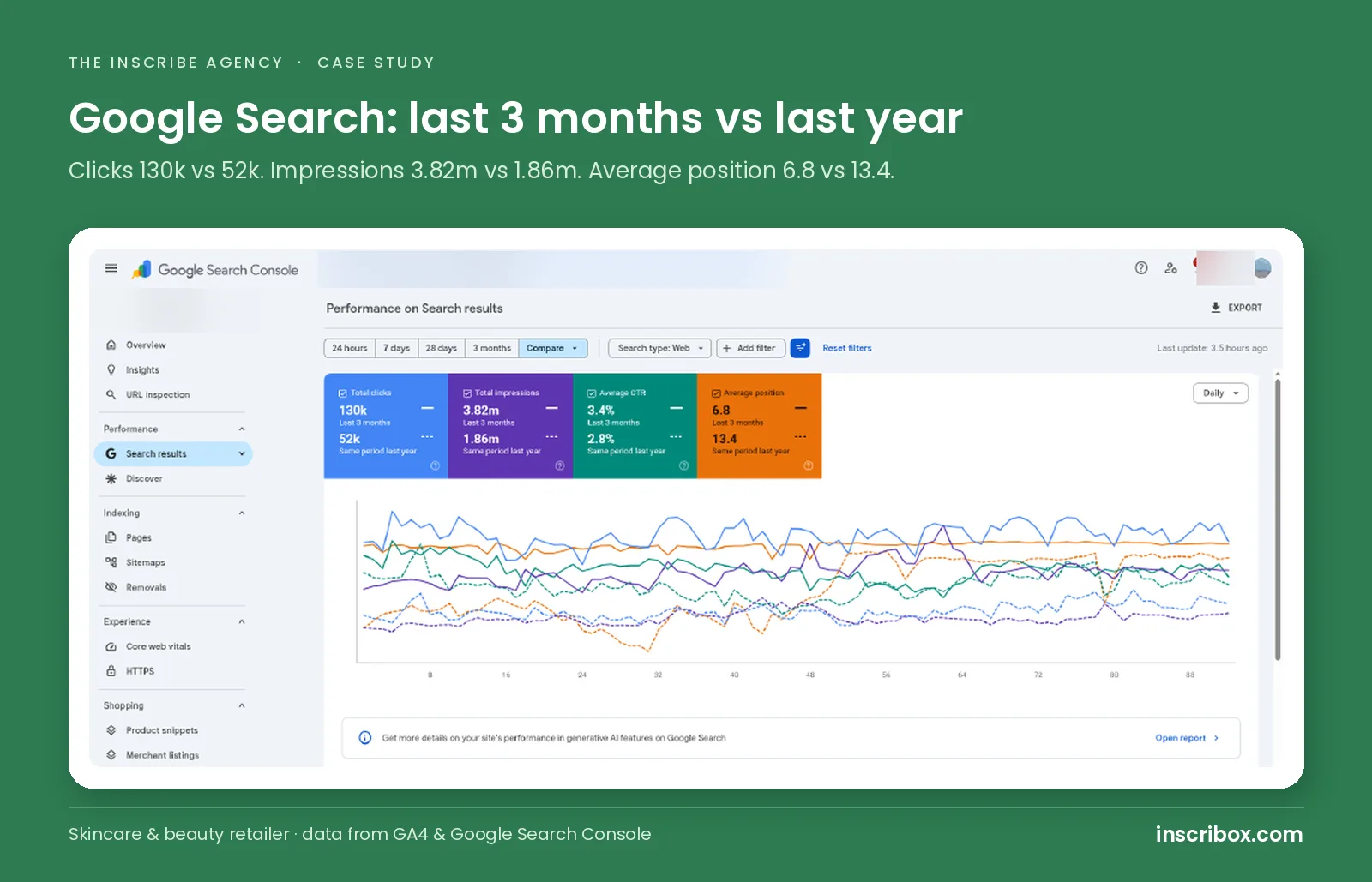
- Monthly Google clicks: 16,333 in September 2025, 42,376 in September 2026 (+159%).
- Monthly impressions: 651,162 to 1,381,896 over the same months (+112%).
- Average position: 12.1 to 6.7. From page two to page one.
- Last three months vs the same three months a year earlier: 130k clicks against 52k, 3.82 million impressions against 1.86 million, and an average position of 6.8 against 13.4. The earlier window falls mostly before we started.
- Pages earning visits: in Q3 2026, 195 pages other than the homepage each brought in 100+ organic visits, and guides and product reviews brought in 12,079 organic sessions.
- Shoppers who didn't know the name yet: of the top 1,000 search terms in Search Console, 947 don't include the retailer's name, and 808 of those have an average position in the top 10. These are people searching for acne treatments like tretinoin, adapalene and azelaic acid, sunscreens, body lotions and Korean skincare.
That last point is what good skincare SEO looks like. Most of the growth comes from people who had never heard of the store, searching for an ingredient or a product type, and finding it on page one. And that made us incredibly happppy.
What About AI Search? Answer Engine Optimization In Practice
More and more shoppers don't start on Google. They ask ChatGPT.
"What's a good azelaic acid gel for dark spots?" "Which sunscreen works for oily skin?" The AI answers, names a few products, and links to where you can buy them.
So who gets named?
Mostly the stores that already rank on Google. ChatGPT, Gemini and Copilot look things up on the web before they answer, so they lean on the same pages search engines already trust. A page that answers a question clearly, ranks on page one and has clean product information is the page AI tools quote.
That's why we don't treat SEO and AEO (answer engine optimization) as two separate jobs. We layer AEO strategies on top for sure, but SEO serves the foundation.
Frequently asked questions
In this case, rankings moved in the first month: average Google position went from 12.1 in September 2025 to 8.6 in October 2025. Traffic took longer. It dipped 1.6% in the second quarter, organic search became the #1 channel six months in, and sessions were up 120.8% at nine months.
The numbers here point that way. AI assistant visits grew from 194 in Q2 2026 to 2,035 in Q3 2026, the same quarter the store's Google rankings hit their best. ChatGPT sent 96.7% of all AI assistant sessions. That's timing, not proof of cause, but the same pages that rank on Google are the pages AI tools look up.
No. Of the top 1,000 search terms sending this store traffic, 947 don't include its name. Most of the growth came from shoppers searching for ingredients and product types, not the brand.
For this retailer: purchase tracking so search revenue shows up, a keyword map that gives every page one job, category pages named the way shoppers search, product pages written for search, a blog plan built on 12 topic pillars, and links pointed at the pages that deserve to rank.
Start with the products, not the brand. List every product type the store sells, research each one, and pick one main keyword per product type. Then split it by intent: transactional searches go to category and product pages, "best" and "vs" searches go to guides, and "how to" questions go to guides or FAQs. If the main keyword is too competitive, filter for purchase intent and difficulty and win the easier variations first.
Blog posts. Someone searching "best sunscreen for oily skin" wants a comparison before they buy, so a guide fits that search better than a category page. The category page goes after the shopping search ("sunscreen for oily skin"), and the guide links to it.
Usually naming. The work runs on the same three parts we used here: technical SEO, content and links. But many beauty brands name their ranges and products with made-up names nobody searches for, so the store only shows up for people who already know the brand. Fixing that, by naming category and product pages after what shoppers type into Google, is usually the first win.
Want this for your brand?
We get ecommerce, DTC and B2C brands ranked on Google and recommended by AI. Book a call and we'll show you where your search traffic is today.
Book your strategy callCo-founder at The Inscribe Agency