Product Page SEO Case Study: How We Grew a Health and Beauty Brand's Google Clicks 726% in 9 Months

Toro has 4+ years of SEO and content marketing experience. At The Inscribe Agency, she leads AEO (Answer Engine Optimization) research, experiments and strategies that drive revenue for clients. Inscribe has generated over $10 million for its clients.
TL;DR
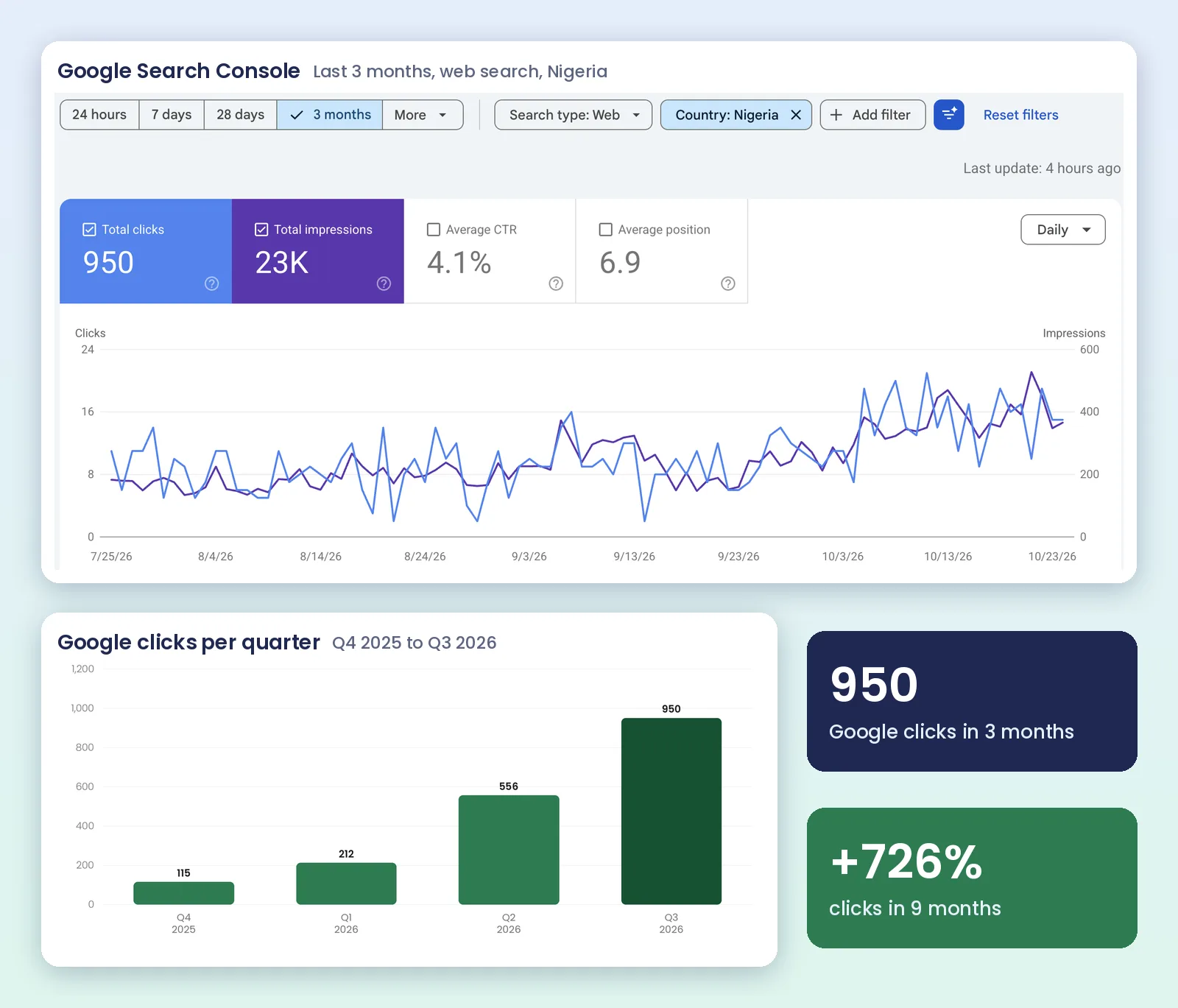
- Google clicks rose 726% in 9 months, from 115 in our first quarter (Q4 2025) to 950 in Q3 2026, and monthly clicks went from 34 in October 2025 to 385 in September 2026 (+1,032%).
- Clicks from buying searches rose 1,138%, from 16 in Q4 2025 to 198 in Q3 2026, counting searches with price, cost, buy, shop, where to, original or the country name in them.
- One product page ranks for 340 searches, 262 of them in Google's top 10, and that single page earns 24% of all the site's Google clicks.
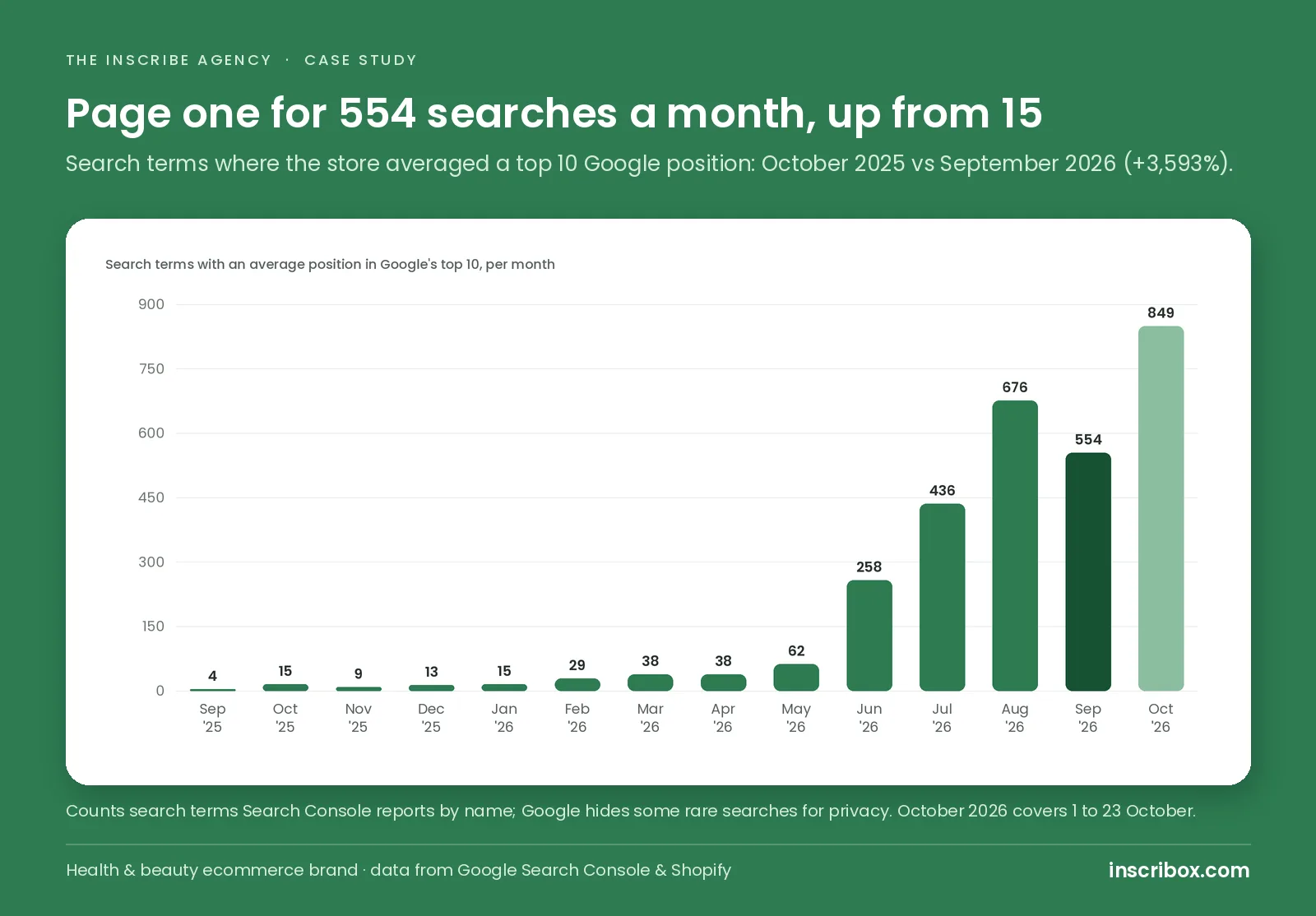
- The store reached page one for 554 searches a month, up from 15, comparing October 2025 with September 2026.
- Product pages now win the most clicks, rising from 76 in Q4 2025 to 403 in Q3 2026 (+430%), and in October 2026 they passed the blog for the first time.
Earlier on in 2026, we onboarded a health and beauty store – selling weight-management and wellness products online.
In its first two weeks on Search Console, Google sent the store 5 clicks.
Nine months after we started, Google was sending it 950 clicks a quarter, one product page was ranking for 340 different searches, and the store was on page one for 554 searches a month.
This product page SEO case study walks through every quarter from that starting point to nine months in, with the charts behind every number. It also shows the work: the keyword research, the product and collection pages, the content plan and the links. It's the same process we run for any DTC brand that wants Google and LLMs to send it buyers, not just browsers.
Where Was The Store Before We Started?
The website was completely new and had zero traffic from Google.
A store with no search presence is like a pharmacy on a street with no sign. The people who already know it's there walk in. Everyone else walks past, then buys from whoever they can find.
So the brief was simple: make Google (and LLMs) a channel this store could lean on, and make it send people who are ready to buy.
Our Health And Beauty SEO Process, Step By Step
Step 1: Product-first keyword research
There are three ways to do keyword research for an online store. You can start from your own domain, which shows what already ranks. You can start from a competitor's domain, or you can start from the products. We often combine all three depending on the brand niche.
For this brand, that meant listing every product type it sells first, then we researched one product type at a time and split each one three ways by intent:
- Transactional: the shopper wants to buy now. These searches go to a product page or a collection page.
- Commercial: the shopper is comparing prices, products or sellers. These go to a guide.
- Informational: the shopper is learning how to use, dose or store something. These go to a guide, or into an FAQ on the product page.
In health and beauty, the commercial searches are where the money is. Someone typing a product name plus "price in X country" isn't browsing. They've decided what they want and they're working out where to buy it and what it should cost. So we gave those searches priority from day one.
If a main keyword is too competitive for a store at its stage, we don't throw money at it. We open the full list of variations, filter for purchase intent, filter by keyword difficulty and win the easier ones first. Each win builds trust with Google, and the harder terms get easier once the store has it.
Step 2: Store structure & product page SEO optimization
Most of the wins come from structure: which pages exist, what they're called, and which search each one is there to rank for.
- Name pages the way shoppers search
- Let product titles match the search: in September 2026, the flagship product was renamed to the way shoppers search for it: the product name, the format and the country. Product-page clicks went from 143 in September to 233 in the first 23 days of October.
- Create collection pages for every variation people search for: if enough people search for a product class, it gets its own collection page instead of a filter nobody can find on Google
Step 3: A content plan built around buying questions
For a health and beauty brand selling weight-management products, customer questions were specific. What does it cost? Where can I buy the original? Which one is better for me? How do I inject it? How do I store it in this heat? What results do people get?
So that's what we wrote. The content plan for this brand runs on four pillars:
- Price and where-to-buy guides
- Product comparisons (product A vs product B)
- How-to guides
- Before-and-after stories and reviews (customer transformations)
It worked.
Step 4: Directories, citations, links
The next part of our process is links: other websites pointing to the store. Google treats a link from a relevant, trusted site the way you'd treat a recommendation from a friend who knows the subject.
We point links at the pages that already deserve to rank (the strong product pages and the guides at the centre of each pillar), so every link has somewhere useful to send its authority.
Through our PR work, we placed a link on a national news site pointing to the where-to-buy guide, and it sent buyers straight to that guide.
Content and structure come first. Links make good pages rank faster, and get more recommended by AI.
3 Months In (Q1 2026): The Store Starts Showing Up
Clicks went up 84%. By March, the store was showing up for 213 search terms a month, and blog posts were earning clicks in numbers.
6 Months In (Q2 2026): Google Starts Sending Shoppers
Clicks went up 162% in the quarter before. The price and comparison guides were ranking, and the product pages were ranking alongside them.
9 Months In (Q3 2026): Google Clicks Up 726%
- 950 Google clicks: up 71% in Q2 and up 726% in our first quarter.
- 198 clicks from buying searches: up from 16 in Q4 2025.
- Page one for 554 searches: in September, up from 15 in October 2025.
- 403 product-page clicks: up 430% on Q4 2025.
- 2,465 visits from search engines in Shopify: up from 147 in Q4 2025.
- Commercial searches: searches with buying intent (price, cost, buy, shop, where to, original or the country name in them) made up 60% of the clicks Google reports by search term.
- Shoppers who didn't know the name yet: 89% of the clicks Google reports by search term came from searches without the brand's name.
And October 2026 kept going. In its first 23 days the store took 473 Google clicks (more than any full month before it), and ranked in the top 10 for 849 search terms. The average position across everything it ranks for went to 5.8, from 23.2 in April.
Frequently asked questions
In this case, rankings moved first: search terms with a top 10 position went from 4 in September 2025 to 38 in March 2026. Clicks grew 84% in the second quarter, 162% in the third and 71% in the fourth, for 726% growth from our first quarter to nine months in. The biggest single jump was in June 2026, eight months in.
Yes. This store had 7 search terms and 5 clicks on Google in September 2025. Nine months later it ranked in the top 10 for 554 search terms a month.
Because shoppers search for what a product is, not what a brand calls it. Many stores give products made-up names nobody searches for, so the page only shows up for people who already know the brand. On this store, the flagship product was renamed in September 2026 to the way shoppers search for it, and product-page clicks went from 143 in September to 233 in the first 23 days of October.
By matching every way a shopper describes the product: the name, the specifications, the format, the price and the country, plus the questions they ask before buying. On this store, one weight-management product page ranks for 340 searches, 262 of them in Google's top 10, and earns 24% of the site's Google clicks.
Both, with different jobs. Product and collection pages go after buying searches. The blog goes after comparison, price and how-to searches, and links shoppers to the products. Here, blog posts led on clicks for most of 2026, and product pages passed them in October 2026.
For this brand: a keyword map that gives every page one job, collection pages named after what people search for, product titles that match the search, a content plan built on four pillars (price guides, comparisons, how-tos and before-and-after stories), and links pointed at the pages that deserve to rank.
The same pages that rank on Google are the pages AI tools look up, alongside third-party websites.
Want this for your brand?
We get ecommerce, DTC and B2C brands ranked on Google and recommended by AI. Book a call and we'll show you where your search traffic is today.
Book your strategy callCo-founder at The Inscribe Agency