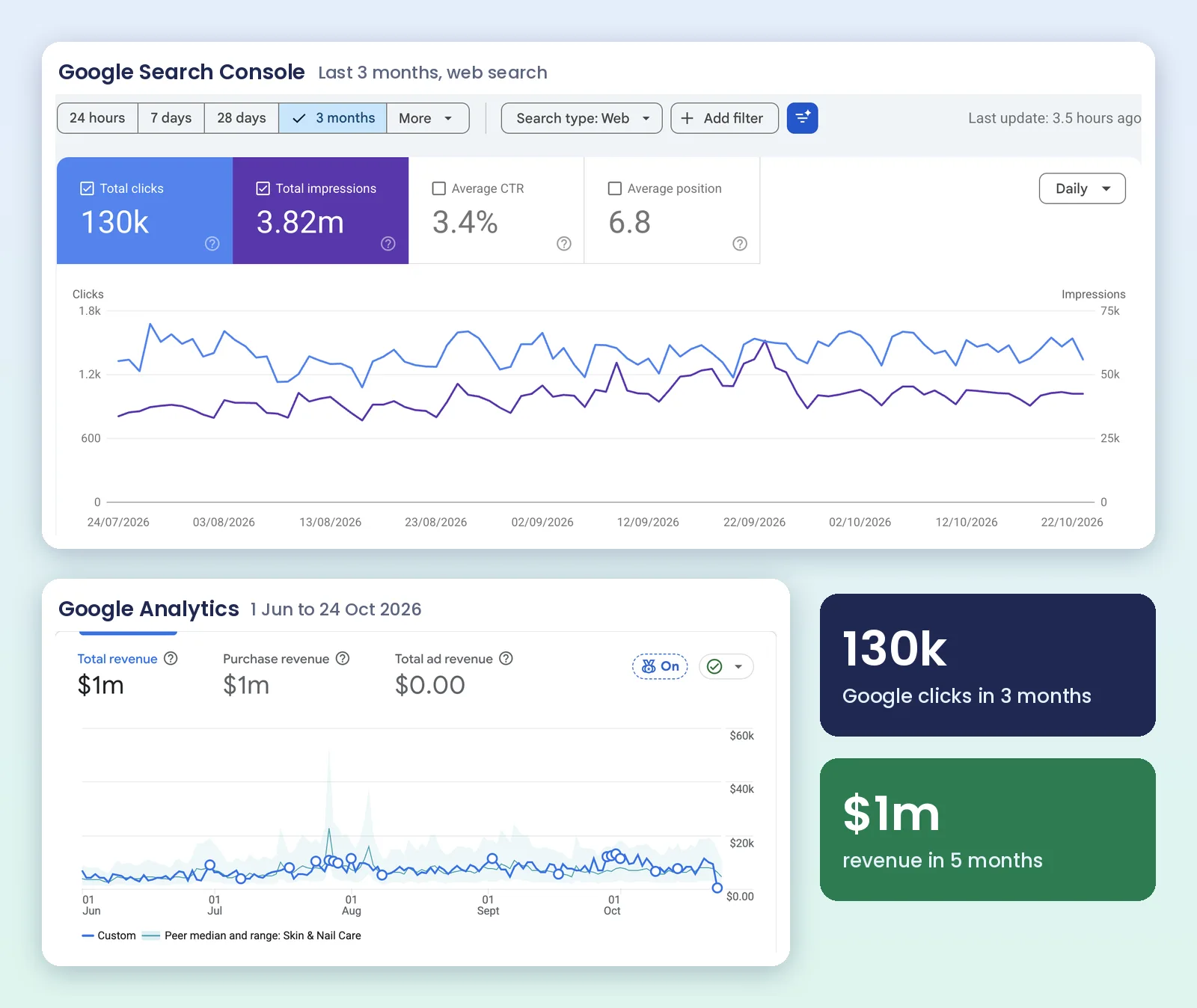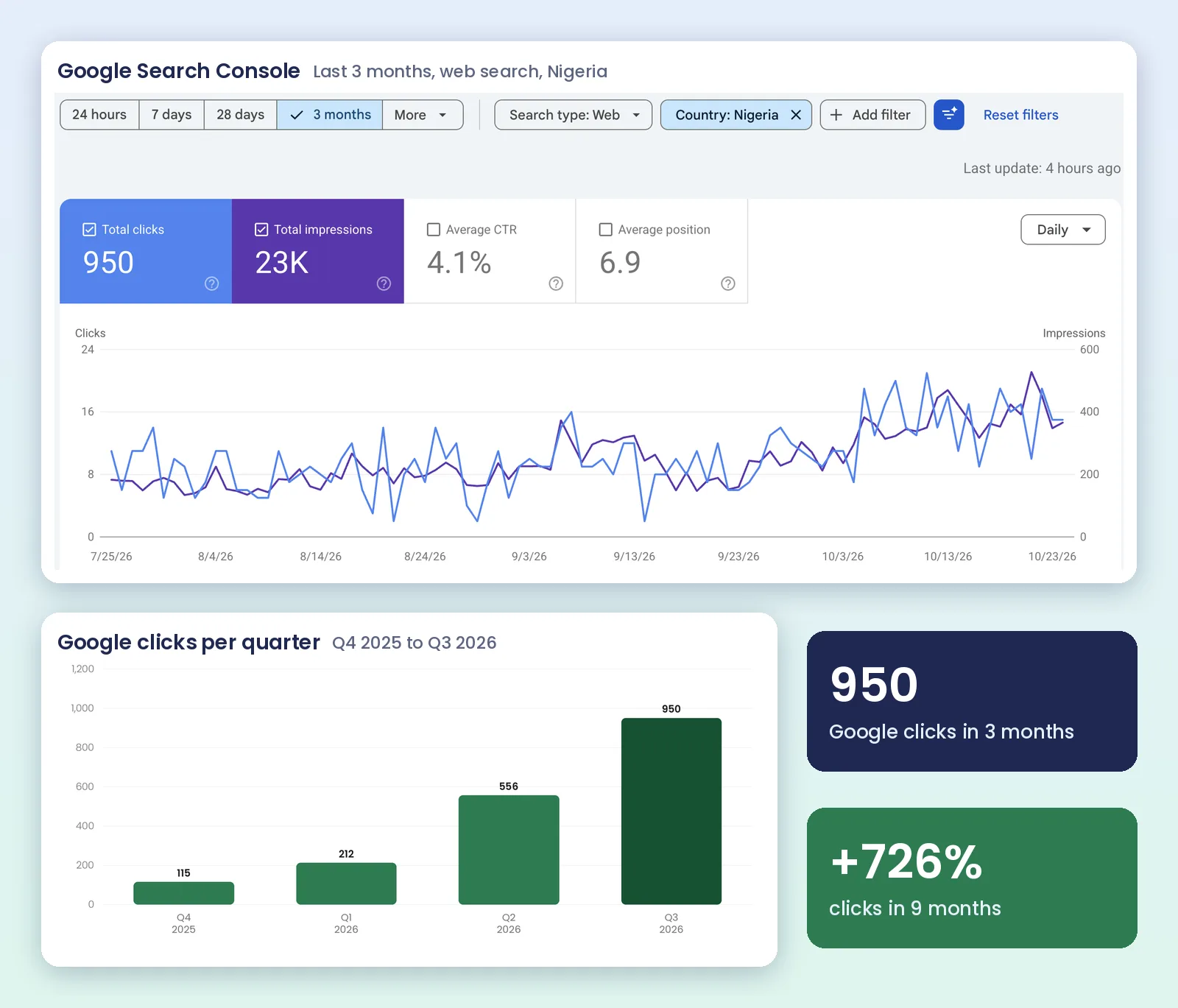
Shopify SEO Case Study: How New Collection Pages Grew a DTC Sunglasses Brand's Organic Traffic 47.9% in 5 Months, and Still Rank Today

Toro has 4+ years of SEO and content marketing experience. At The Inscribe Agency, she leads AEO (Answer Engine Optimization) research, experiments and strategies that drive revenue for clients. Inscribe has generated over $10 million for its clients.
TL;DR
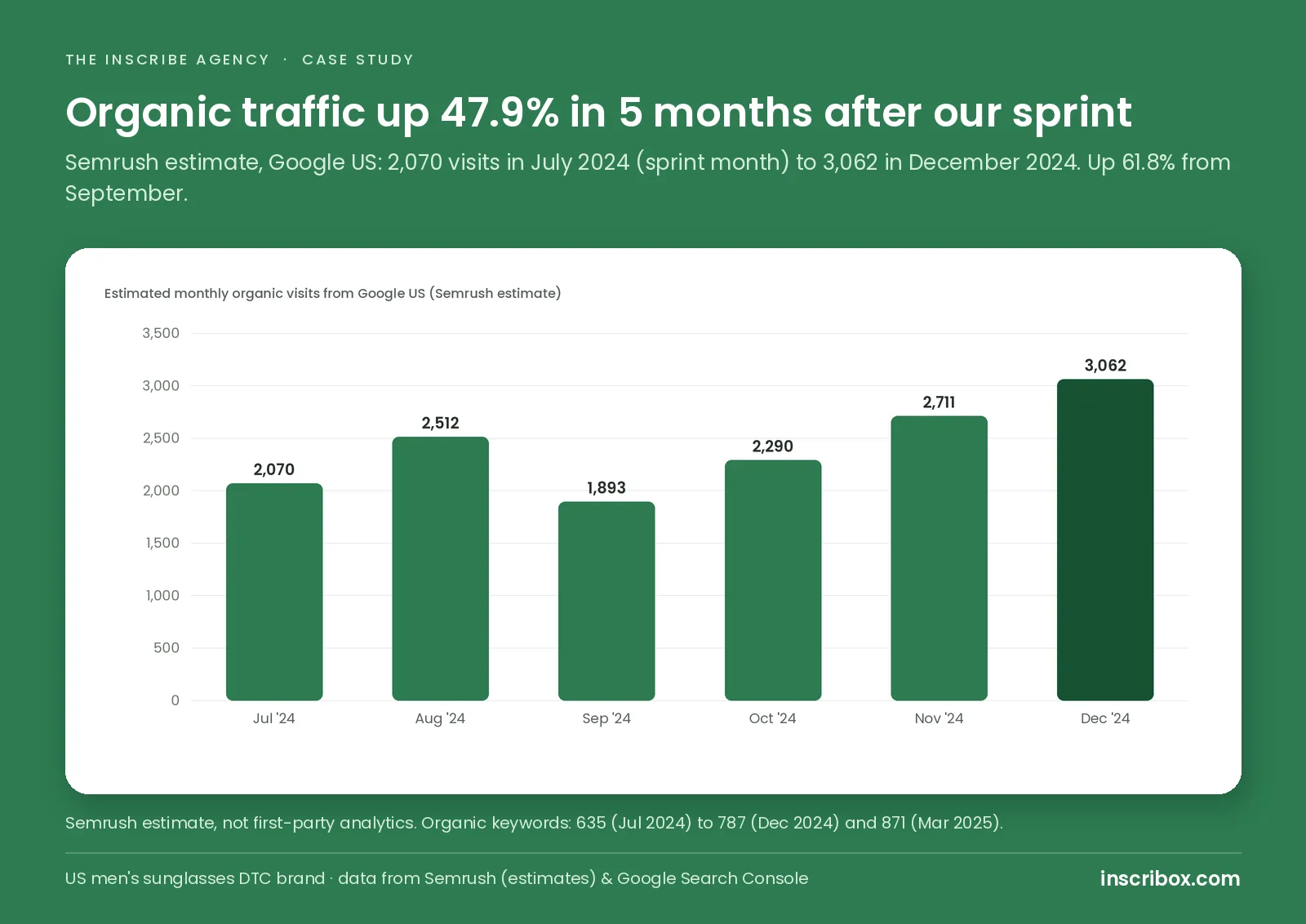
- Organic traffic rose 47.9% in 5 months, from an estimated 2,070 monthly visits from Google US in July 2024 (the sprint month) to 3,062 in December 2024, and 61.8% from September 2024.
- Organic keywords rose 37.2%, from 635 in July 2024 to 871 in March 2025, still going up eight months after the sprint.
- One collection page ranks for 593 searches: the hunting sunglasses collection, with 405 of them in Google's top 10, 229 in the top 3, and an average position of 2.2 for "hunting sunglasses".
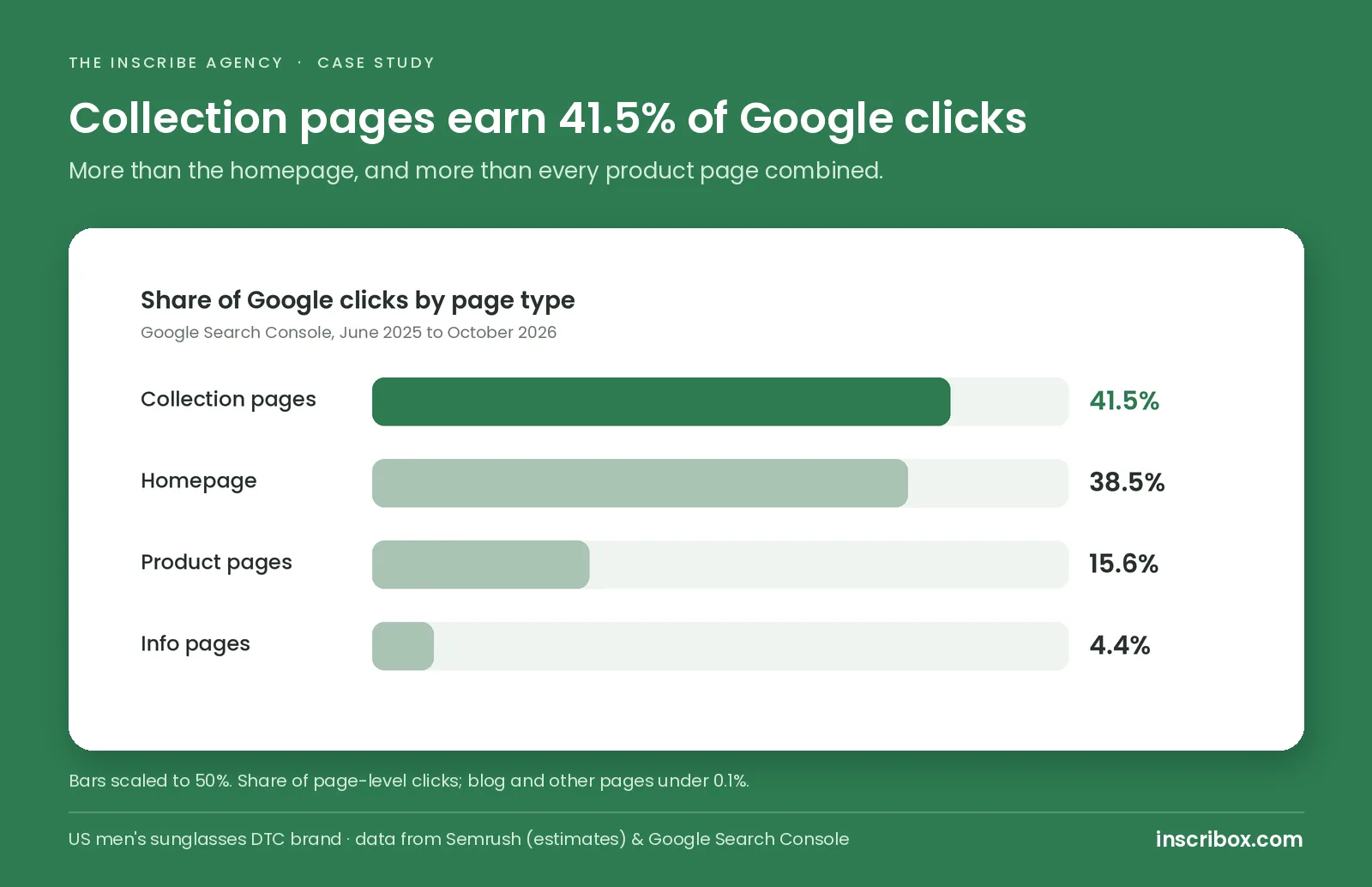
- Collection pages earn 41.5% of the store's Google clicks, more than the homepage (38.5%) and more than all product pages combined (15.6%).
- Site-wide average position went from 27.6 to 10.0, comparing Q3 2025 with Q3 2026, with click-through rate up 78.1%.
In mid 2024, a US men's sunglasses brand reached out to us at the Inscribe Agency for SEO. They sell polarized, fishing and hunting sunglasses from their own Shopify store.
The products were good, but Google didn't know which pages to send shoppers to. Someone searching "hunting sunglasses" or "fishing glasses to see fish" had no page on the site built for that search, so the store mostly showed up for people who already knew the name.
So we ran an SEO sprint in July 2024: technical fixes, analytics tracking, new meta titles and descriptions, product page optimisation, and new collection pages built around the searches shoppers make, led by hunting sunglasses and fishing sunglasses.
Those collection pages started ranking within 3 to 4 weeks. More than two years later, the hunting sunglasses collection still ranks in Google's top 10 for 405 different searches.
Where Was the Store Before Our Shopify SEO Sprint?
By the way, this wasn't a dead website. Semrush estimated 2,070 monthly organic visits from Google US in July 2024.
But the store wasn't built around a keyword strategy. There was no collection page for "hunting sunglasses" or "fishing sunglasses", two of the most obvious searches for what the brand sells.
It's a pattern we see on most DTC stores we audit:
- There's no defined keyword strategy.
- The store ranks mostly for its own name, so only people who already know it can find it.
- Whatever content exists goes after early research questions and never meets a shopper who's ready to buy.
Timeline: From Sprint to Still Ranking
July 2024: the sprint
Technical fixes, analytics tracking, new collection pages and product page optimisation. We also deployed our unique SEO strategy. Semrush estimated 2,070 organic visits from Google US that month, from 635 organic keywords.
August 2024: rankings start moving
Within 3 to 4 weeks, the new collection pages were ranking, and organic keywords increased to 701 (up 10.4%).
September to December 2024: five months of growth
Estimated traffic went from 1,893 in September to 2,290 in October, 2,711 in November and 3,062 in December. That's up 61.8% from September and up 47.9% from the sprint month.
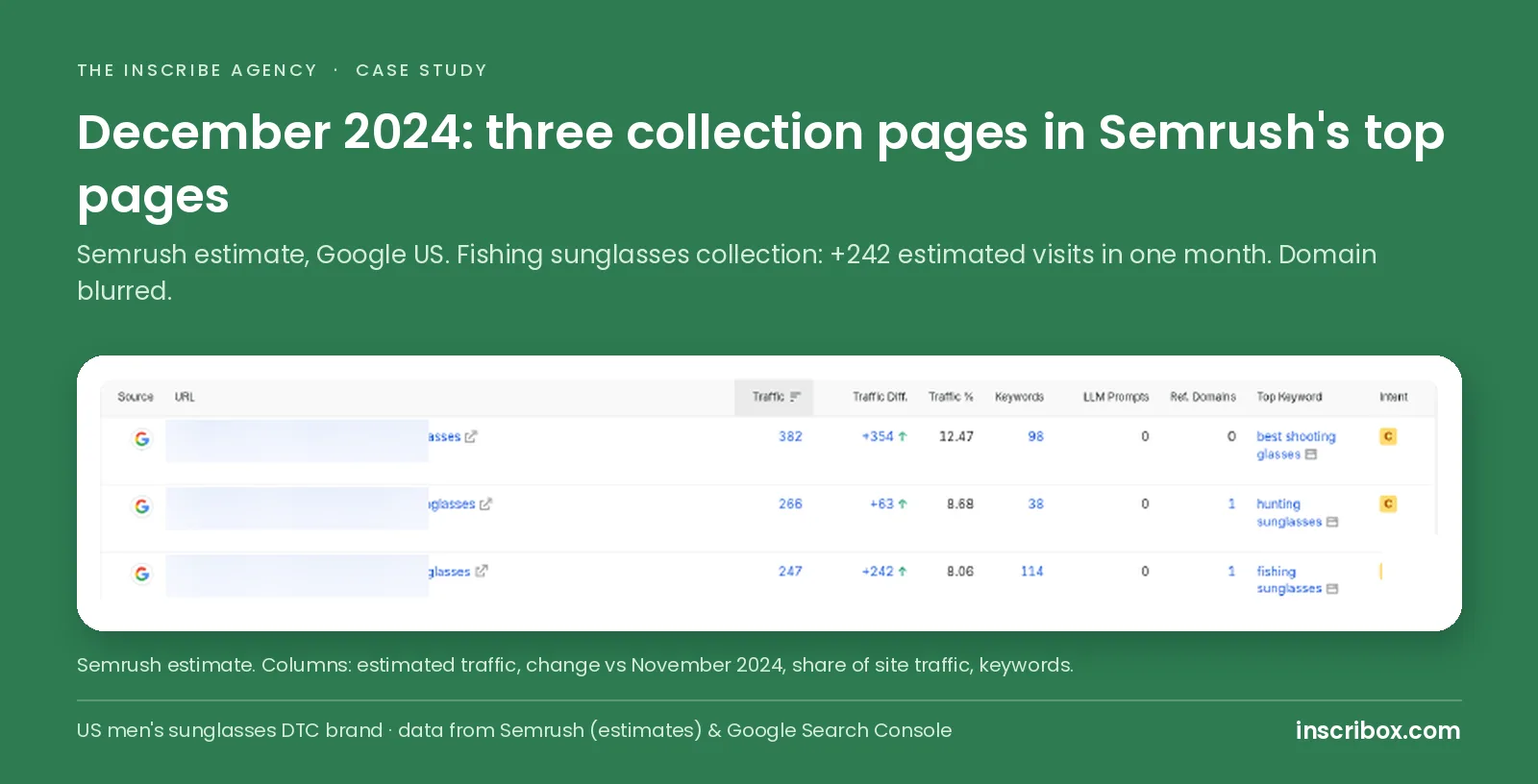
In December, three of the new collections were among the store's top pages for estimated US organic traffic:
January to March 2025: the keywords keep growing
Organic keywords kept rising after the sprint wrapped up: 812 in January, 868 in February and 871 in March 2025. That's up 37.2% on July 2024, eight months after the sprint.
What Changed on Google After Our Shopify SEO Work
The store now ranks for more of the searches shoppers make right before they buy. Comparing Q3 2025 with Q3 2026 in Search Console, for searches that don't include the brand name:
- Fishing searches: clicks up 313.3%
- "Men's" sunglasses and glasses searches: clicks up 175%
- "Polarized" searches: clicks up 87.5% (8 to 15)
- Hunting searches: average position 8.0 to 4.3. The store already ranked for these, and it now owns more of page one.
So… How Did We Get These Results?
While the SEO work we did for this website was only a sprint, we still applied the same process for the foundation. Our process has three parts (technical SEO, content and links), and all three are based on first building a keyword map that tells every page on the store which search it's there to win.
The 2024 sprint focused on the first two: technical SEO and content. So the gains below came from structure, collection pages and on-page work.
Step 1: Product-first keyword research for Shopify based on activity, type, wearer
We built the keyword research in three tiers, each one answering a different question the shopper has when they search.
- Tier 1, the activity: what are the sunglasses for? Hunting, fishing, shooting, driving and so on. Someone searching "duck hunting sunglasses" isn't browsing; they have a trip coming up.
- Tier 2, the type: what kind of sunglasses? Polarized, glass lens, non reflective. The shopper already knows what they want from the lens.
- Tier 3, the wearer: who are they for? Men's sunglasses, women's sunglasses. These are the widest searches, and the hardest to win.
We went activity first, because a store at this stage can't outrank the biggest sunglasses retailers for "men's sunglasses" in a month, but it can win "hunting sunglasses".
Activity searches got their own collection pages: hunting sunglasses, fishing sunglasses and shooting glasses.
Wearer searches went to the men's and women's collections. Type searches didn't need pages of their own, because shoppers stack the tiers in one search ("polarized hunting sunglasses", "hunting sunglasses for men"), so we worked type and wearer keywords into the activity collection pages too.
Here's how the three tiers map out, with what Google Search Console shows for each one today.
| Tier | The shopper's question | Example searches | Mapped to |
|---|---|---|---|
| 1. Activity | What are they for? | hunting sunglasses, duck hunting sunglasses, fishing glasses to see fish, recoil shooting glasses | Hunting sunglasses, fishing sunglasses and shooting glasses collections |
| 2. Type | What kind? | polarized hunting sunglasses, glass lens fishing sunglasses, non reflective sunglasses for hunting | The activity collections |
| 3. Wearer | Who for? | hunting sunglasses for men, best hunting sunglasses for men, mens fishing sunglasses | Men's and women's collections, plus the activity collections |
What the keyword clusters look like for a sunglasses store
The searches in bold send this store Google clicks today.
| Product type | Transactional (collection or product page) | Commercial | Informational (FAQ or guide) |
|---|---|---|---|
| Hunting sunglasses | hunting sunglasses, hunting glasses, duck hunting sunglasses, deer hunting sunglasses | best sunglasses for hunting, best hunting sunglasses for men | non reflective sunglasses for hunting, what color lens for duck hunting |
| Fishing sunglasses | fishing glasses, mens fishing sunglasses, glass lens fishing sunglasses | best sunglasses for hunting and fishing, best polarized fishing sunglasses | fishing glasses to see fish, fishing glasses see through water |
| Polarized sunglasses | polarized hunting sunglasses, glass lens polarized fishing sunglasses | best polarized sunglasses for men | polarized glasses to see fish in water, are polarized sunglasses worth it |
| Lenses | zeiss lens replacement, zeiss replacement lenses | sunglasses with zeiss lenses | what makes zeiss lenses different |
Step 2: Technical Shopify SEO and analytics tracking
Shopify handles a lot of the technical basics, so most of the wins come from structure: which pages exist, what they're called, which one ranks for which search, and whether you can measure any of it.
In the sprint we:
- Fixed the technical issues holding pages back: so Google can find, crawl and understand every page that matters to sales.
- Set up analytics tracking: so the brand could see which searches and pages bring shoppers and sales.
- Rewrote meta titles and descriptions: every important page got a title built around the search it targets and a description written to earn the click. Today the site-wide click-through rate is up 78.1%.
- Defined each page: the keyword map decides which page ranks for which search, so the collection page, the product page and the homepage aren't all competing for the same term.
Step 3: Collection page SEO built around shopper searches
On Shopify, category pages are called collections, so collection page SEO is category page SEO by another name.
We built new collection pages around the searches shoppers make: hunting sunglasses and fishing sunglasses. Each one got the name people type into Google, a URL that matches it, copy that explains what makes a pair right for that use, and FAQs that answer the questions shoppers ask before they buy.
Those pages ranked within 3 to 4 weeks, drove clicks and product sales, and still rank today.
Collection pages are now the store's biggest source of Google clicks
The collection pages now earn 41.5% of the store's Google clicks. That's more than the homepage at 38.5%, and more than every product page combined at 15.6%.
The homepage mostly brings in people who already know the brand. Collection pages bring in the ones who don't.
Step 4: Product pages that back up the collections
Collection pages win the broad shopping searches, and product pages win the specific ones.
We optimised the product pages so each one uses the words a shopper would search for, answers the questions people ask before buying, and keeps the product details clean and structured so Google and LLMs can read them. A frame with a made-up model name still needs to say what it is: polarized, glass lens, built for fishing or hunting.
Step 5: Links
Next up is links: other websites pointing to the store. We point links at the pages that already deserve to rank, the strongest collection pages first.
Content and structure come first. Links make good pages rank faster, and get them recommended more by AI.
Frequently asked questions
In this case, the new collection pages ranked within 3 to 4 weeks. Semrush estimated organic traffic up 21.4% the month after the sprint, and up 47.9% after five months. More than two years later, the hunting collection still holds a top 10 average position every month.
It's building and optimising the collection (category) pages on an online store so each one ranks for a search shoppers make. That means naming the collection after what people type into Google, matching the URL, writing copy around that search, adding FAQs for the questions shoppers ask, and making sure no other page on the store competes for the same term.
Yes, if the store is structured around searches. Shopify handles a lot of the technical basics, but it can't decide which collections the store needs or what to call them. In this case, collection pages built around "hunting sunglasses" and "fishing sunglasses" earn 41.5% of the store's Google clicks.
Only for variations people search for. If shoppers search "hunting sunglasses" and "fishing sunglasses", those are two collection pages. If nobody searches for a variation, a filter is fine. Keyword research decides which is which.
The same three parts we used here: technical SEO, content and links. The difference with DTC brands is naming. Many name their ranges and products with made-up names nobody searches for, so the store only shows up for people who already know the brand. Renaming collections and product pages after what shoppers type into Google is usually the first big win.
For buying searches, collection pages. Someone searching "hunting sunglasses" wants to see products, so a collection page fits that search better than a blog post. Blog posts work best for comparison and "how to" searches, and they link back to the collection.
Good SEO does. The collection pages from this 2024 sprint drove months of growth and still rank today. Organic keywords kept rising for eight months after the sprint (up 37.2% by March 2025), and the hunting collection still ranks for 405 searches in the top 10.
Want this for your brand?
We get ecommerce, DTC and B2C brands ranked on Google and recommended by AI. Book a call and we'll show you where your search traffic is today.
Book your strategy callCo-founder at The Inscribe Agency